
Who We Are
Since August 12, 1998, the San Marcos Greenbelt Alliance has been working to protect the quality of life for the people of San Marcos through the creation of interconnected parks and natural areas. Today, in the midst of unprecedented growth throughout Central Texas, SMGA is dedicated to ensuring that we take care to protect natural areas for ourselves, our children, and our future.
SMGA is a non-profit, 501(c)(3), all volunteer organization that survives on the membership dues, donations, grants, perspiration, brains and brawn of people who understand the value of the natural world. We are governed by a Board of Directors consisting of 11 members.
We celebrate the greenspaces and encourage others to do so with us or in their own way. We help create access and connect these beautiful, valuable places with trails. If you enjoy the natural world, we would love to have you
Texas State students Jarod Phillips and Sonia Onescu created this informative video that describes the work of the San Marcos Greenbelt Alliance.
What We Do
- Conservation: Protect and conserve greenspace by working with stakeholders.
- Stewardship: Maintain the health of greenspaces through community participation.
- Outreach / Education: Promote awareness and understanding of the value of protecting and connecting greenspace.
Our Vision
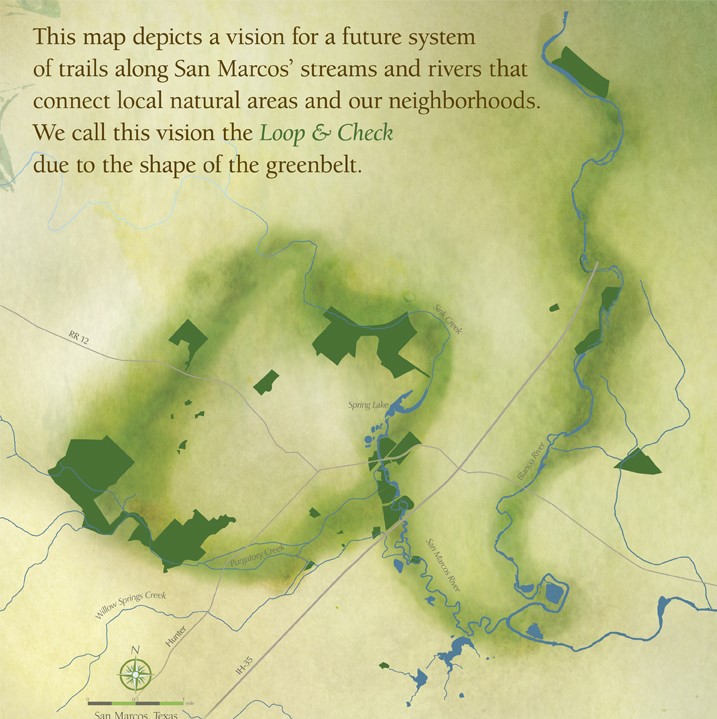
We envision a greenbelt that connects the places where we live, work, learn and play. This greenbelt uses land that is often ignored and neglected and takes advantage of existing parks and sidewalks. It offers an inviting and easy way to move throughout our community as a pedestrian or cyclist, experiencing our natural landscape and heritage along the way. It helps to protect creeks and rivers, our water supply, and habitat for native plants and animals. The greenbelt reduces the impact of severe flooding and offers many other health and safety benefits.
Emerald Crown Trail
SMGA is a partner in the Emerald Crown Work Group in support of Emerald Crown Trail, a proposed trail system that with connections to other trails would eventually link Austin and San Antonio. The Emerald Crown Trail is a proposed trail system that would link Buda, Kyle, San Marcos, and areas of Hays County, with connections to other trails to the north towards Austin and to the south towards New Braunfels and San Antonio.
Partners
We are fortunate to live in a city with great people: people with vision, people who care about the environment, people willing to share, for the benefit of their community. There are more than 1,200 acres set aside just as natural areas. This was done for many reasons: flood mitigation, water quality, air quality, wildlife protection, recreation for residents and visitors, tourism, transportation by foot or bicycle, nature classrooms and more.
San Marcos Greenbelt Alliance partners with the City of San Marcos www.sanmarcostx.gov, the Mayor and Council, the City staff, especially Parks and Recreation, Park Rangers, and GIS department.
We also partner with the Texas Master Naturalist program, Hays County chapter http://haysmn.org. They, with the Hill Country Photography Club http://www.hcphotoclub.org manage and display photography in an annual exhibit aptly named, “Naturescapes.”
We are indebted to the San Marcos River Foundation http://www.sanmarcosriver.org for our start in 1998. They provided reason, purpose and funding when we were starting.
Texas State University http://www.txstate.edu/, especially the Biology, Geography and English Departments have provided knowledge and experience over these two decades.
We are also appreciative of the efforts and funding provided by Texas Parks & Wildlfe Department http://www.tpwd.state.tx.us and the U.S. Fish & Wildlife Service www.fws.gov
We appreciate our many partners who give their time, expertise, and financial support to make our natural areas what they are today.





Thanks to our Sponsors